Cottage Courts Are Now
Legal in Madison.
Here’s Everything
You Need to Know.
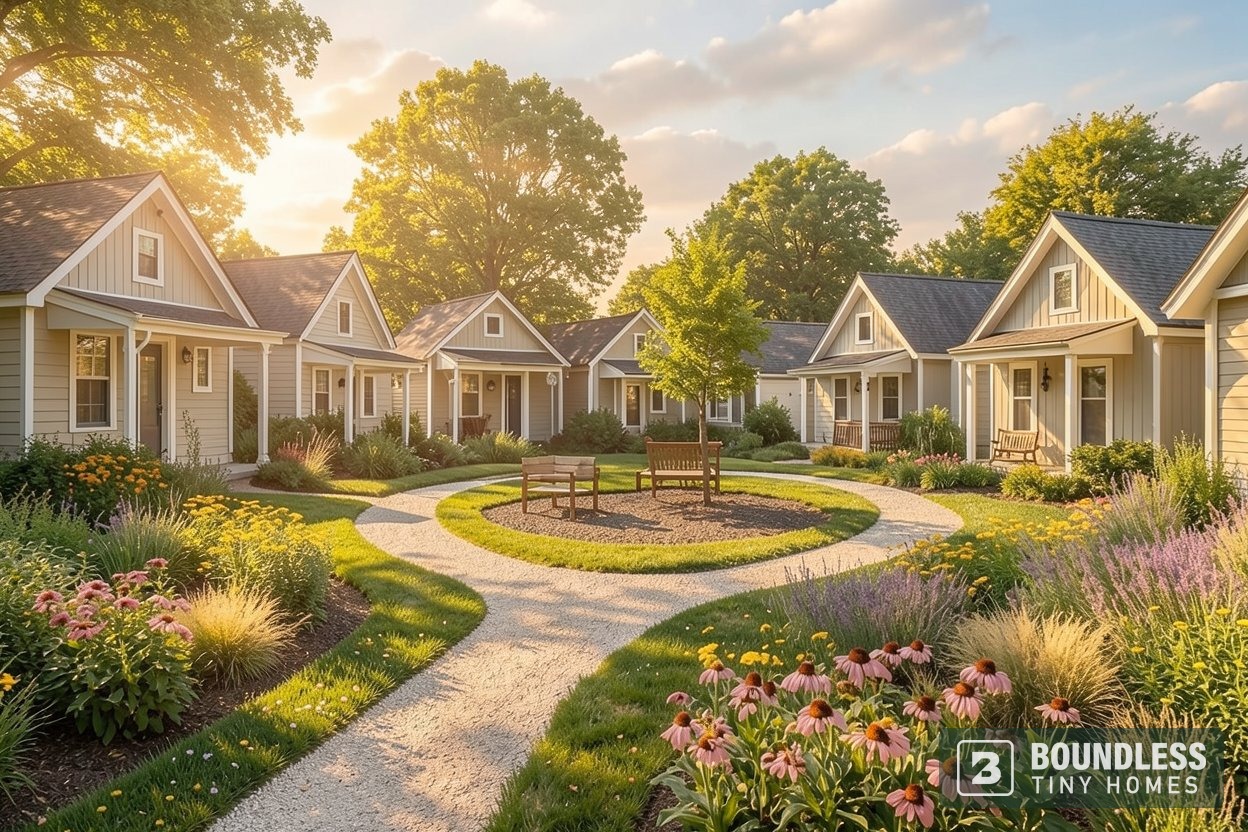
Madison just passed Ordinance 90557, creating a new housing type called cottage courts — clusters of up to eight small homes arranged around a shared courtyard on a single lot. We’ve read the ordinance, mapped the eligible zones, and laid out exactly what it takes to make one work.
Small Homes. Shared Courtyard. One Lot.
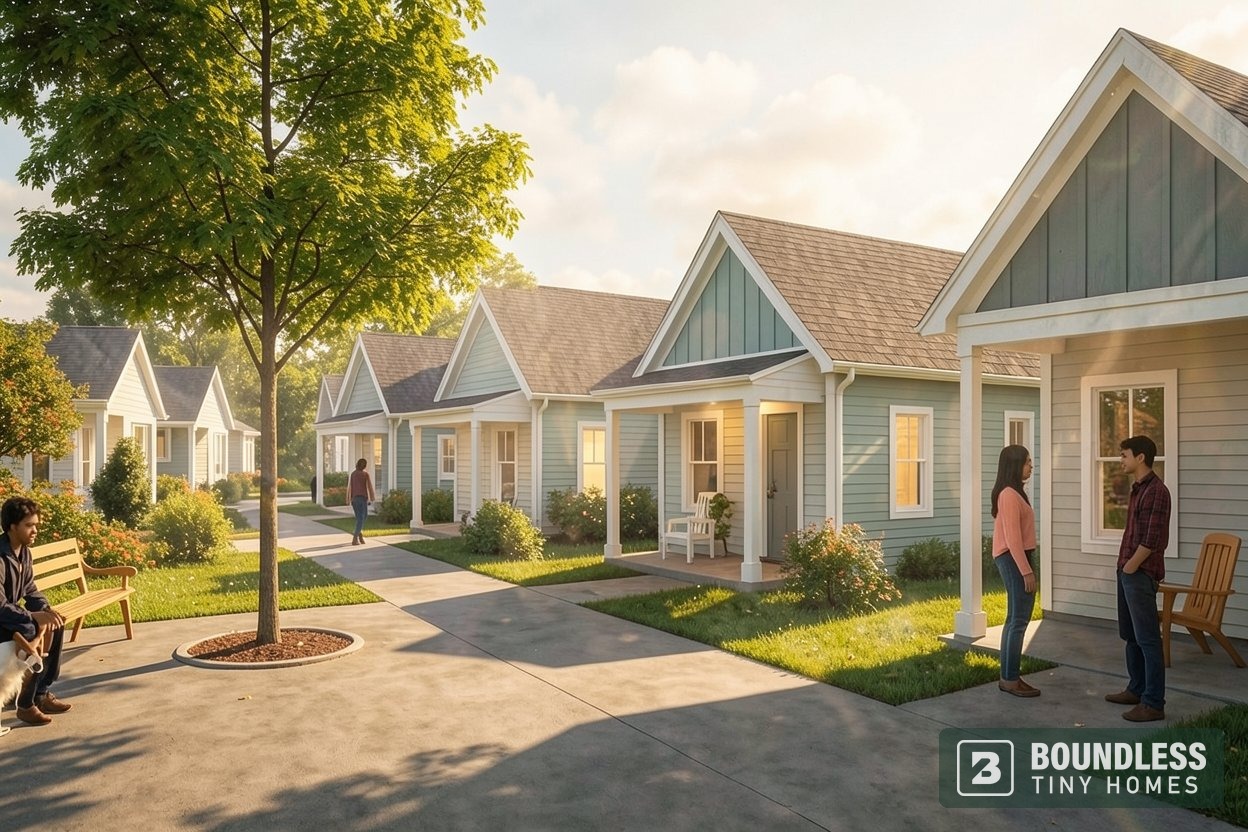
A cottage court is a group of small, detached homes arranged around a central shared courtyard — all on a single parcel of land. The concept dates back to the bungalow courts of 1920s California and is now recognized as one of the best examples of “missing middle” housing: density that fits into an existing neighborhood without looking like an apartment complex.
Each home is fully detached and independent. Residents share the courtyard, parking, and common access — but the homes themselves function like any single-family dwelling. They can be rented, owner-occupied, individually sold as condominiums, or put on their own subdivided lots.
The City of Madison passed Ordinance 90557 in December 2025, making cottage courts a permitted use by right across nearly all residential zones in the city. No conditional use permit required. No public hearing. If your lot qualifies, you can build.
What the Ordinance Actually Requires
These are the specific standards set by Madison’s ordinance. They apply citywide — no exceptions unless noted.
| Requirement | Standard |
|---|---|
| Lot size | 10,000 sq ft minimum — 1 acre maximum |
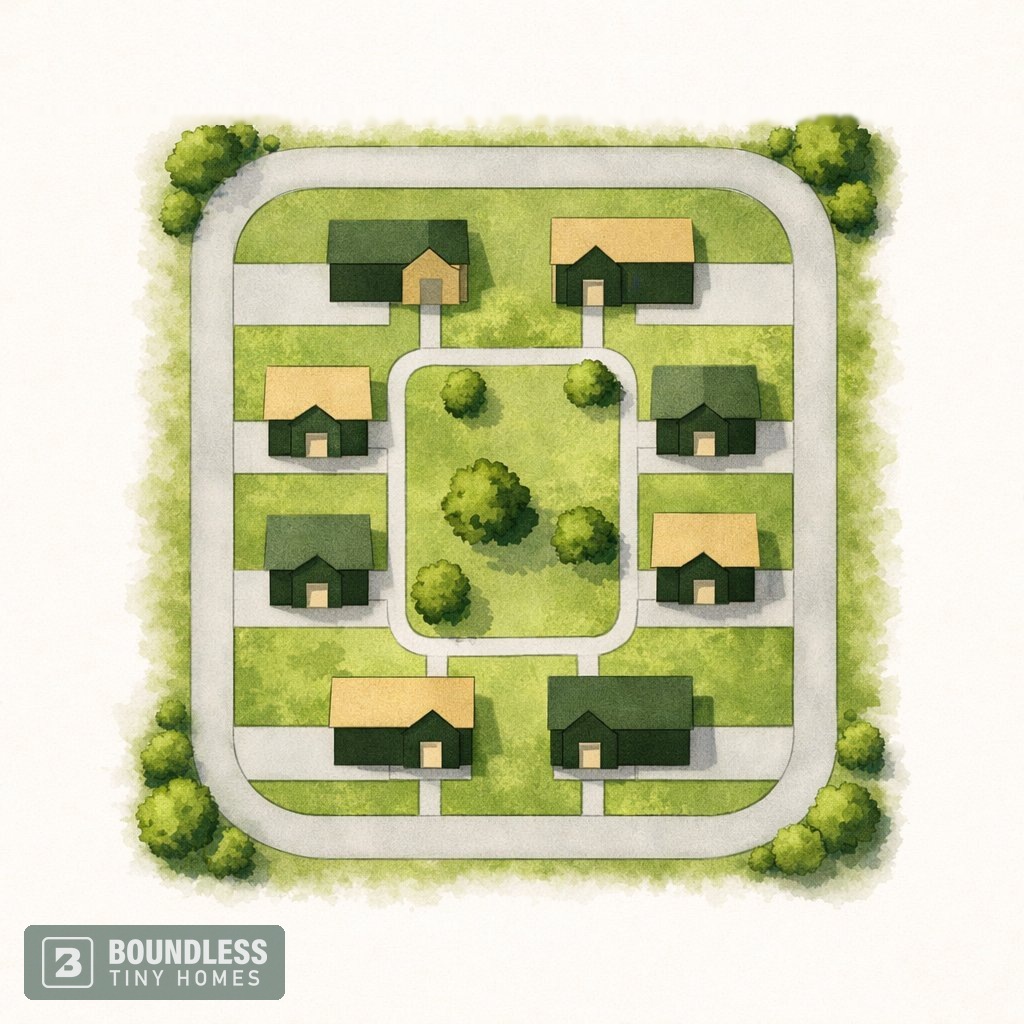
| Units allowed | Up to 8 (including any existing home on the lot) |
| Unit types | Single-family detached, twin homes, duplexes, or any combination |
| Home footprint | 1,000 sq ft maximum per dwelling (multi-story allowed) |
| Home separation | 6 ft minimum between structures |
| Rear setback (lot perimeter) | 8 ft |
| Required courtyard | Minimum 20 ft × 20 ft — no vehicles, no buildings |
| Parking minimum | None required |
| Parking maximum | 2 spaces per unit (1.5 in TOD overlay) |
| Parking design | Single shared lot — no individual driveways or attached garages |
| ADUs on same lot | Not permitted within a cottage court lot |
| Architectural requirements | None — no required materials, colors, or roof pitch |
| Permit type | Permitted use by right — no conditional use permit required |
Most standard Madison lots run 6,000–9,000 sq ft and won’t qualify on their own. You’ll likely need a larger single parcel or to assemble two adjacent lots. That’s not a dealbreaker — it’s the starting point for site selection.
No attached garages per unit. Parking must be centralized. That’s a real consideration for buyers and renters in a Wisconsin winter. Smart site design and covered walkways can mitigate this — but it needs to be designed for, not ignored.
Once a parcel is developed as a cottage court, ADUs are off the table. If ADU income was part of your financial model, that changes the math.
400 sq ft (20×20) is the bare minimum, and sidewalks count toward it. A well-designed cottage court should treat the courtyard as an asset, not a checkbox — size it generously.
Where Cottage Courts Are Allowed in Madison
Cottage courts are permitted in virtually all of Madison’s residential zones — with one exception. The two high-density zones immediately surrounding UW-Madison’s campus (TR-U1 and TR-U2) are excluded. Everything else — the near east side, near west side, south side, north side, Middleton border neighborhoods, and suburban residential areas — is eligible, provided the lot meets the 10,000 sq ft minimum.
TR-U1 and TR-U2 — the highest-density residential zones on and immediately adjacent to the UW-Madison campus — are the only zones excluded from the cottage court ordinance. All other residential zones in Madison are eligible.
Not sure about your zone? A feasibility check confirms zoning eligibility for your specific address — along with lot size, setbacks, and a realistic unit count. Start here →
Cottage Courts Aren’t for Everyone.
Here’s Who They’re Actually For.
The ordinance is structured around smaller homes, shared infrastructure, and alternative ownership models. That points to a specific set of buyers, developers, and project types.
You want a smaller home but not an apartment. You want neighbors but not shared walls. A cottage court offers the privacy of a detached home with built-in community — and a footprint that actually makes sense for one or two people.
A lot between 10,000 sq ft and an acre in an established Madison neighborhood, developed into 4–8 small homes, is a genuinely interesting infill play. Homes can be individually condominiumized and sold, which exits the project rather than holding rental inventory indefinitely.
Some families want proximity without a shared roof. A cottage court on a family-owned lot can house multiple generations independently while keeping everyone on the same property. It’s the ADU concept — scaled up.
Who it’s not for: Anyone who needs an attached garage, a standard-depth backyard, an ADU alongside the main house, or a conventional suburban layout. The ordinance is designed around a different product than the typical Madison single-family home — and that’s the point.
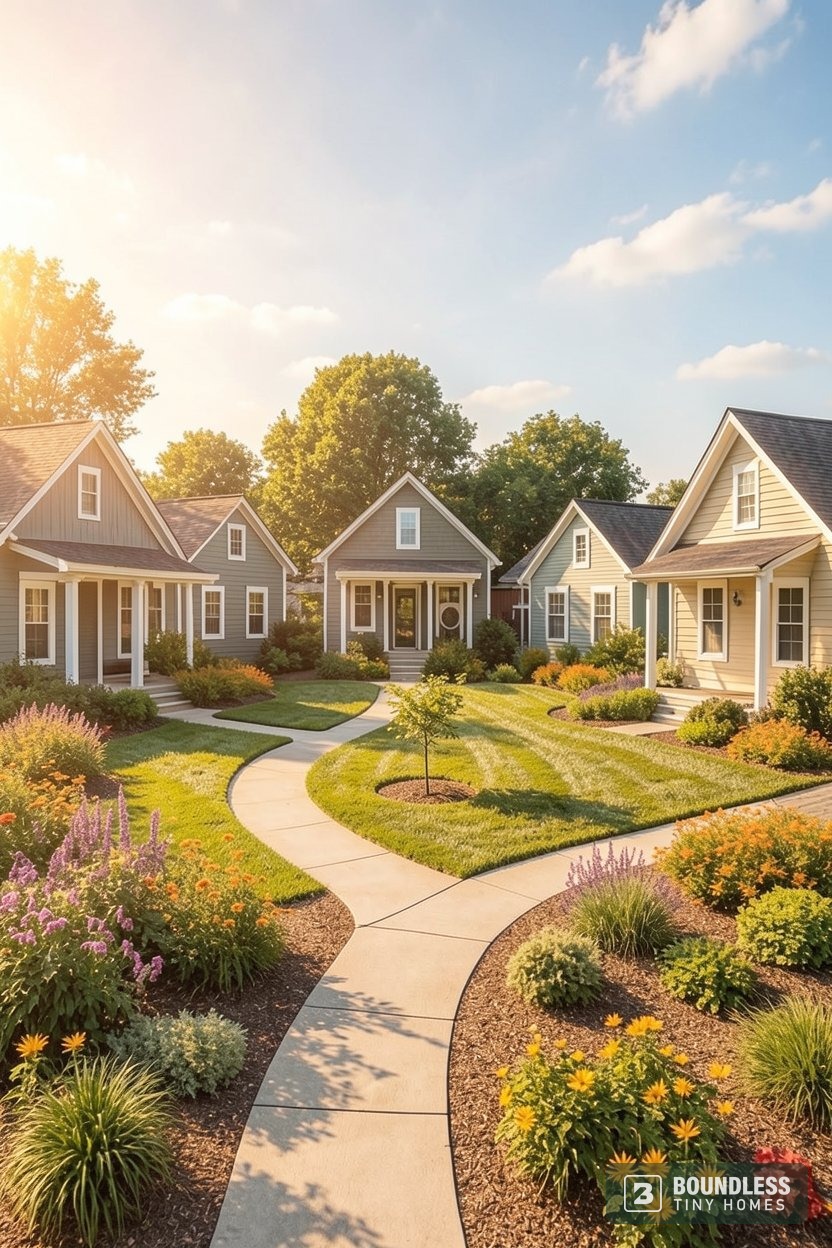
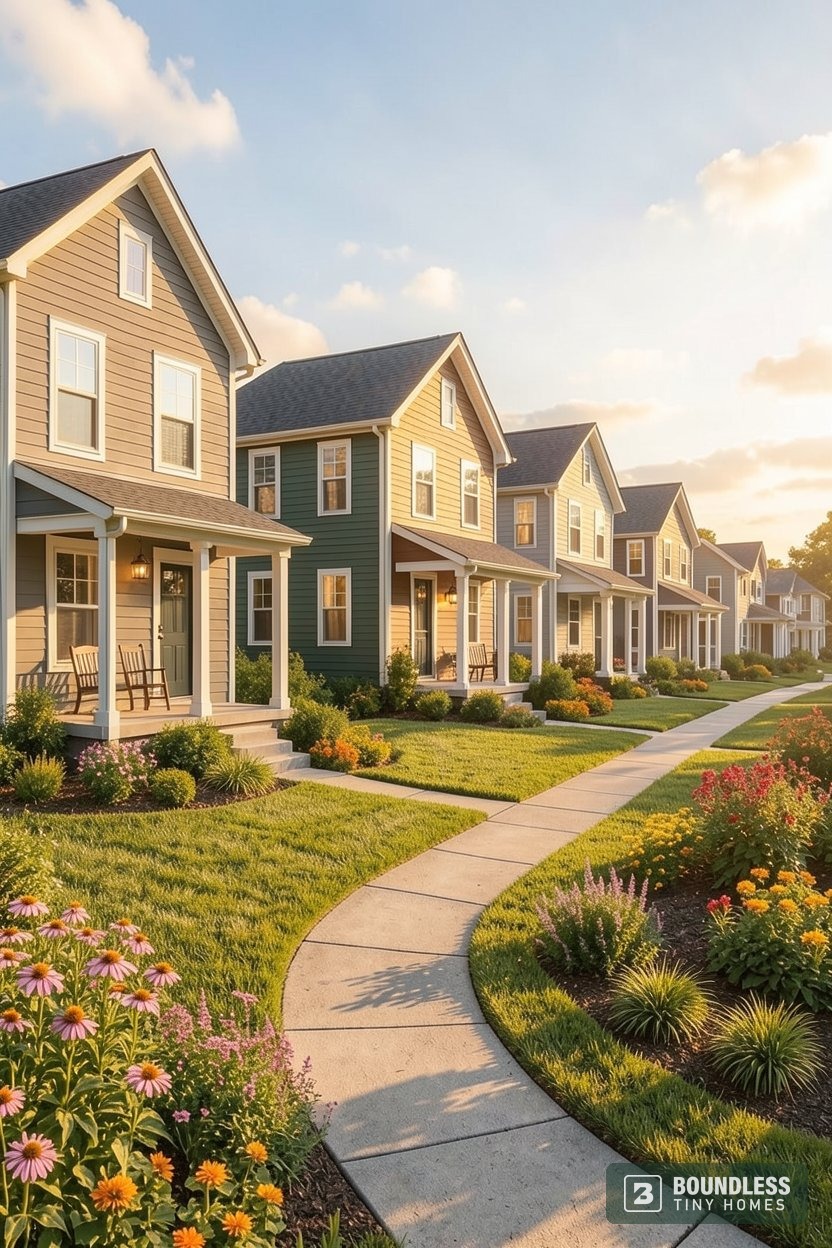
Renderings are illustrative. Actual designs and finishes vary by project.
How a Cottage Court Development Actually Works
There’s no shortcut to developing a cottage court, but there’s also no mystery. The process follows the same general path as any residential project in Madison — with a few cottage-court-specific considerations layered in.
The starting point is the lot. You need a parcel between 10,000 sq ft and 1 acre in an eligible residential zone. Feasibility means understanding the lot’s shape, existing structures, utility access, topography, and how many units can realistically be placed while meeting setback, separation, and courtyard requirements. This is not a back-of-napkin calculation — it requires an actual site analysis.
Cottage courts live or die by their site plan. Where the courtyard sits, how units orient to it, where shared parking lands, how pedestrians move through the site — these decisions determine whether the project feels like a community or a parking lot with houses around it. We develop a site plan that treats the courtyard as the centerpiece, not an afterthought.
Each home is capped at 1,000 sq ft of footprint — but that’s not a ceiling on livability. Well-designed small homes use multi-story construction, open plans, and smart storage to live larger than their footprint suggests. We design to Wisconsin energy code: proper insulation, cold-weather HVAC, and envelope performance that holds up when temperatures drop to the single digits.
Because cottage courts are a permitted use by right, you’re not going before the Plan Commission or seeking a conditional use permit. You’re filing for a standard building permit — the same process as any new residential construction. We handle plan preparation, city submission, and management of the review process. Typical permitting runs 4–8 weeks in Madison.
We build on-site, not from a factory floor. That means the homes are built to your parcel’s conditions — foundation type appropriate for Wisconsin frost depth, framing to local code, finishes selected to hold up in the climate. Construction typically runs 4–6 months per structure, with sequencing across a multi-unit site planned to minimize disruption and keep the project moving.
Before construction is complete, you need a plan for how the property is held and transferred. Options include keeping the parcel whole with all units as rentals, establishing a condominium association so units can be individually sold, or subdividing lots where site geometry allows. We’ll help you think through the right structure — and connect you with the right legal and title professionals to execute it.
Small Homes Are What We Do.
Not a Side Project.
General contractors build houses. We build small homes — specifically, precisely, and only in Dane County. Every process we’ve developed, every subcontractor relationship we’ve built, every permitting relationship we’ve cultivated with Madison’s Building Inspection division is calibrated for this type of work.
Cottage courts are, at their core, a collection of small homes on a shared site. That’s exactly the work we do every day. The design considerations — maximizing livable space within a 1,000 sq ft footprint, building for Wisconsin’s energy code, managing small-structure permitting, sequencing multi-unit construction — are not new problems for us. They’re our entire practice.
A general contractor treating a cottage court as a larger version of a custom home project will make it harder and more expensive than it needs to be. We won’t.
Our entire portfolio is sub-1,000 sq ft detached structures. We know how to make them livable, efficient, and worth building.
We’ve been through Madison’s Building Inspection process dozens of times. We know the reviewers, the timeline, and where projects get stuck — and how to keep them moving.
We track every ordinance change in Madison and surrounding municipalities. We were reading Ordinance 90557 the week it passed.
Common Questions About
Cottage Courts in Madison
Own a Large Lot in Madison?
Let’s Look at What’s Possible.
A cottage court feasibility check starts with your address. We’ll confirm zoning eligibility, assess lot size and geometry, and give you a straight answer on whether a cottage court is a viable path — and if so, how many units, what layout, and what it takes to get there.
No ambiguity. No sales pressure. Just answers.
Boundless Tiny Homes · Dane County’s ADU Specialists · Madison, WI